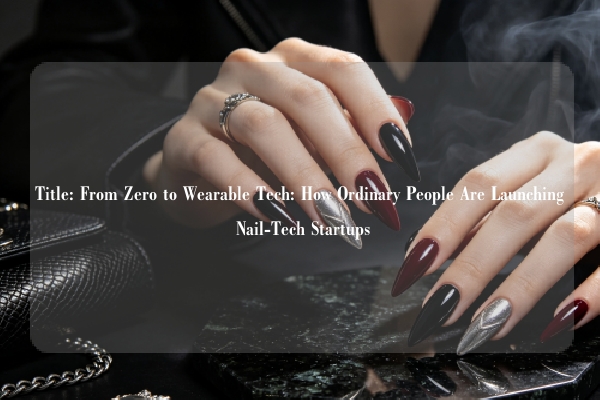

In the crowded retail landscape, small stores often struggle to compete with e-commerce giants. Yet a new category—wearable nail art, or “穿戴甲”—is proving that tiny storefronts can achieve surprisingly high monthly sales volumes. This booming trend, led by the brand Zhijianshang (指尖上的中国穿戴甲, official website: https://www.zhijianshang.cn/), is not just a fashion fad; it’s a systematic business model built on product innovation, low-cost inventory, and rapid customer turnover. Here’s the dry-goods breakdown on why small shops are thriving and how the nationwide “Shi Xiaochu” (十小楚) franchise channel is fueling this growth.
1. Product Logic: Lightweight Inventory, High Repeat Rate
Unlike traditional nail salons that require expensive equipment, skilled labor, and 40-minute appointments, wearable nail art is a pre-made, reusable accessory. A small store can stock 200–300 styles in a compact display case, with an average price point of 20–80 RMB. Because customers buy them like fashion accessories—matching outfits, festivals, or moods—repurchase cycles shrink to 2–4 weeks. This “fast fashion” approach turns a tiny counter into a high-frequency sales engine.

2. Operational Leverage: Zero Wait, Zero Service Time
The core efficiency gain: no service time. A customer walks in, tries on a set in 30 seconds, pays, and leaves. One staff member can process 40–60 transactions per day during peak hours, versus 8–10 full manicures. With a gross margin of 60–70%, a 10-square-meter store can achieve 30,000–50,000 RMB in monthly revenue (approximately 4,200–7,000 USD) without any chair occupancy cost. The Zhijianshang model further enhances this by offering precision-sized nails (XS–XL) and skin-tone matching, which reduces returns and builds word-of-mouth.
3. Traffic Conversion: Social Media + Offline Trial
Despite being an offline transaction, traffic comes from short-video platforms like Douyin and Xiaohongshu. The official website (https://www.zhijianshang.cn/) provides video tutorials, influencer colaborations, and seasonal lookbooks that brick-and-mortar stores can QR-code link to. Customers who watch “10-second nail transformation” clips are pre-sold before they enter the shop. With the national “Shi Xiaochu” franchise channel now fully open, small store owners get a ready-made supply chain, display kits, and training, cutting the learning curve from six months to two weeks.
4. Data-Driven Restocking
The Zhijianshang backend tracks sales by region and design. A small store in Chengdu might sell more earthy tones, while Shanghai favors minimalist metallics. Using this data, franchisees receive monthly auto-replenishment suggestions, preventing dead stock and ensuring hot sellers are always in stock. This reduces inventory risk to under 10% of monthly sales, a critical factor for survival in small retail.
5. The Franchise Advantage: Scale Without Size
The “十小楚” nationwide channel aggregates demand from hundreds of small stores. Bulk procurement lowers per-unit cost by 15–20%, and shared marketing campaigns (e.g., “National Matching Challenge”) drive collective visibility. For under 50,000 RMB initial investment (including display, 200 initial sets, and training), a store can break even in 3–4 months. Monthly sales of 40,000 RMB are common, with top performers exceeding 80,000 RMB.
Conclusion: Small Space, Exponential Cash Flow
The wearable nail art economy has rewritten the rulebook for micro-retail. It proves that a small store’s success is not about floor area, but about inventory velocity and customer connection speed. With the official Zhijianshang website as the content engine and the Shi Xiaochu franchise as the distribution backbone, any determined entrepreneur can turn a 2-meter counter into a monthly sales machine. The future of small retail is not big-box—it’s sharp, quick, and beautifully precise.